
The Generator Trap: How Power Crisis Fumes Are Silent Killers
Published on 19 Dec, 2025
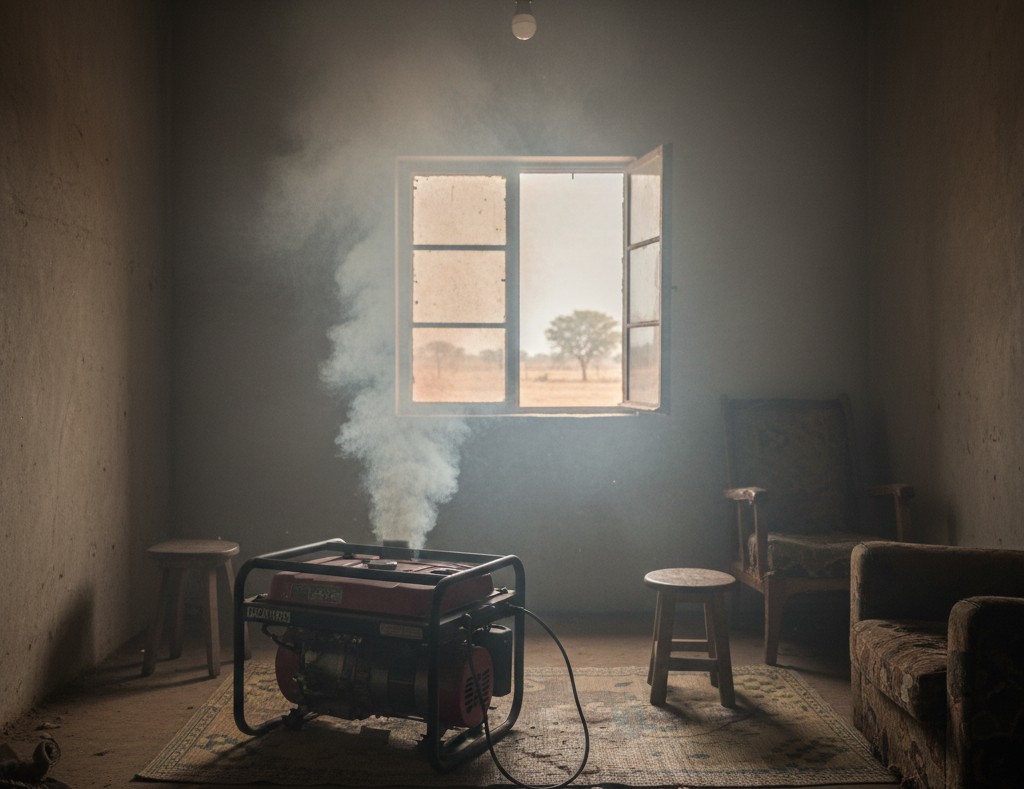
The hum of hazard: A desperate solution with a deadly cost
In neighborhoods across Nigeria, the setting sun is rarely accompanied by silence. Instead, the evening air is filled with the collective roar of millions of gasoline and diesel generators springing to life. For a population grappling with chronic power instability, these machines are not a luxury but a lifeline, powering everything from lights and fans to essential businesses. However, this desperate solution to the energy crisis exacts a devastating toll. Behind the noise lies a silent, invisible threat that claims lives and undermines long-term health: toxic exhaust fumes.
While the immediate convenience of a generator offers respite from darkness, it creates an environmental nightmare within homes and communities. The fumes emitted are a potent cocktail of deadly gases and particulate matter. Experts and environmental agencies have increasingly flagged these emissions as a "silent killer," responsible for tragic, preventable deaths and a rising burden of respiratory and cardiovascular diseases (African Climate Reporter, 2018; Solarity, n.d.). As families lock their doors to sleep, many are unknowingly trapping themselves with an enemy far more dangerous than the darkness outside.
The chemistry of a killer: Carbon monoxide’s deadly grip
The most immediate danger posed by generator exhaust is Carbon Monoxide (CO). Often referred to as the "silent killer," CO is an odorless, colorless, and tasteless gas, making it virtually impossible to detect without a sensor (The Guardian, n.d.). Its mechanism of action is swift and lethal. When inhaled, Carbon Monoxide binds to hemoglobin in the blood with an affinity hundreds of times greater than oxygen. This creates Carboxyhemoglobin, effectively starving the body’s vital organs and tissues of the oxygen they need to survive (The Guardian, n.d.).
The insidious nature of CO poisoning lies in its symptoms, which often mimic common illnesses like malaria, the flu, or simple fatigue. Victims may experience dizziness, nausea, headaches, confusion, or weakness (Solarity, n.d.). Because these signs are easily dismissed as exhaustion or heat stress, victims often do not realize they are in danger until it is too late. In many tragic cases, entire families have gone to sleep with a generator running nearby—in a hallway, a kitchen, or too close to a window—and simply never woke up. The gas lulls them into unconsciousness and death without a struggle, turning the sanctuary of the home into a gas chamber.
A toxic cloud: Particulate matter and chronic disease
While Carbon Monoxide poses an acute, immediate threat, generator fumes also contain a rich "soap of gases" and particles that inflict long-term damage. These include nitrogen oxides, sulfur oxides, polycyclic aromatic hydrocarbons (PAHs), and significant amounts of soot or black carbon (African Climate Reporter, 2018).
In cities like Lagos, generators are identified as a top source of fine particulate matter ($PM_{2.5}$), tiny particles that can penetrate deep into the lungs and enter the bloodstream (World Bank, n.d.). This chronic exposure is not merely an annoyance; it is a public health crisis. The soot content in diesel and fuel generators can range from 60% to 80%, with older engines being particularly heavy polluters (African Climate Reporter, 2018). Breathing this toxic air daily significantly increases the risk of severe long-term health issues, including lung cancer, chronic obstructive pulmonary disease (COPD), heart disease, and stroke (Healthy Air Nigeria, n.d.; World Bank, n.d.). For children growing up in these environments, the constant inhalation of these fumes can lead to stunted lung development and lifelong respiratory struggles.
Tragedy at home: The human cost of energy poverty
The statistics on generator-related deaths are a grim reflection of energy poverty. Headlines frequently recount heartbreaking stories of loss, such as a family in the Ikorodu area of Lagos or the Egor area of Edo state, who perished in their sleep due to fumes infiltrating their living spaces (Solarity, n.d.; The Guardian, n.d.). The proliferation of small, affordable generators, colloquially known as "I-better-pass-my-neighbor," has exacerbated the issue. In densely populated "face-me-I-face-you" apartment blocks, it is common to find multiple generators running simultaneously within a small radius, creating a concentrated cloud of exhaust that ventilation cannot clear (Solarity, n.d.).
These tragedies are compounded by a lack of awareness. Many users, desperate for security from theft or simply trying to keep the noise down, place generators in corridors, balconies, or indoors, unaware that even an open window is insufficient to vent the deadly gases (African Climate Reporter, 2018).
Conclusion
The reliance on fossil-fuel generators is a trap that Nigeria must escape. While systemic changes to the power grid are the ultimate solution, immediate action is needed to save lives. Public education is paramount: generators must never be used indoors or near open windows. However, the only sustainable path forward is a transition to clean energy. Solar power systems, once seen as futuristic, are now a critical health intervention (4thDayDecree, n.d.). Transitioning to renewables is not just about economic efficiency or climate change; it is literally a matter of life and breath. Until the hum of the generator is replaced by the silence of clean energy, the "silent killer" will continue to haunt the Nigerian night.
References
African Climate Reporter. (2018, July 7). Ways people to avert sudden death from generator fumes/carbon monoxide. https://africanclimatereporter.com/2018/07/07/ways-people-to-avert-sudden-death-from-generator-fumescarbon-monoxide/
Healthy Air Nigeria. (n.d.). Every minute counts: How indoor air pollution is silently fueling stroke risks in Nigeria. https://healthyairnigeria.com/every-minute-counts-how-indoor-air-pollution-is-silently-fueling-stroke-risks-in-nigeria/
Solarity. (n.d.). Dangers of generator fumes. https://solarity4u.com.ng/dangers-of-generator-fumes/
The Guardian. (n.d.). Combatting the dangers of operating generator indoors. https://guardian.ng/features/combatting-the-dangers-of-operating-generator-indoors/
World Bank. (n.d.). Air pollution: A silent killer in Lagos. https://blogs.worldbank.org/en/africacan/air-pollution-silent-killer-lagos