
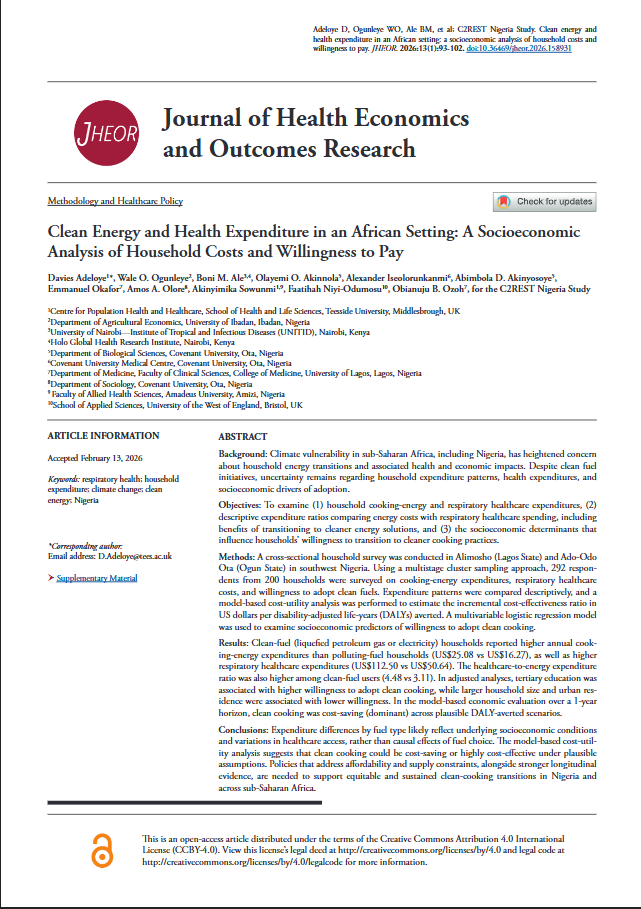
Clean Energy and Health Expenditure in an African Setting: A Socioeconomic Analysis of Household Costs and Willingness to Pay
Last Update : 21 Mar, 2026
Lay Summary
Climate change and economic challenges in sub-Saharan Africa, including Nigeria, are raising concerns about how families cook their food and how this affects their health and finances. Many households still rely on firewood or charcoal, which can harm both the environment and people’s health. Cleaner options such as gas or electricity exist, but it is still unclear how much families spend on cooking energy and health care, and what factors influence whether they switch to cleaner fuels.
To better understand this issue, researchers surveyed 292 people from 200 households in two areas of southwest Nigeria: Alimosho in Lagos State and Ado-Odo Ota in Ogun State. Participants were asked about how much they spend on cooking fuel, how much they spend treating breathing-related illnesses, and whether they are willing to switch to cleaner cooking fuels such as gas or electricity.
The study found that households using cleaner fuels generally spend more money each year on cooking energy than those using traditional fuels like firewood or charcoal. They also reported higher spending on respiratory health care. However, this likely reflects differences in income levels and access to health care rather than the type of fuel directly causing these costs.
The study also showed that people with higher education were more willing to adopt clean cooking fuels. In contrast, larger households and those living in urban areas were less willing to change their cooking practices.
Overall, the analysis suggests that switching to cleaner cooking fuels could improve health and even save money in the long term by reducing illnesses linked to smoke from traditional fuels. To support this transition, policies should focus on making clean fuels more affordable and easier to access, while also encouraging further research to better understand how households adopt cleaner cooking solutions.
Abstract
Background
Climate vulnerability in sub-Saharan Africa, including Nigeria, has heightened concern about household energy transitions and associated health and economic impacts. Despite clean fuel initiatives, uncertainty remains regarding household expenditure patterns, health expenditures, and socioeconomic drivers of adoption.
Objectives
To examine (1) household cooking-energy and respiratory healthcare expenditures, (2) descriptive expenditure ratios comparing energy costs with respiratory healthcare spending including benefits of transitioning to cleaner energy solutions, and (3) the socioeconomic determinants that influence households’ willingness to transition to cleaner cooking practices.
Methods
A cross-sectional household survey was conducted in Alimosho (Lagos State) and Ado-Odo Ota (Ogun State) in southwest Nigeria. Using a multistage cluster sampling approach, 292 respondents from 200 households were surveyed on cooking-energy expenditures, respiratory healthcare costs, and willingness to adopt clean fuels. Expenditure patterns were compared descriptively, and a model-based cost-utility analysis was performed to estimate the incremental cost-effectiveness ratio in US dollars per disability-adjusted life-years (DALYs) averted. A multivariable logistic regression model was used to examine socioeconomic predictors of willingness to adopt clean cooking.
Results
Clean-fuel (liquefied petroleum gas or electricity) households reported higher annual cooking-energy expenditures than polluting-fuel households (US$25.08 vs US$16.27), as well as higher respiratory healthcare expenditures (US$112.50 vs US$50.64). The healthcare-to-energy expenditure ratio was also higher among clean-fuel users (4.48 vs 3.11). In adjusted analyses, tertiary education was associated with higher willingness to adopt clean cooking, while larger household size and urban residence were associated with lower willingness. In the model-based economic evaluation over a 1-year horizon, clean cooking was cost-saving (dominant) across plausible DALY-averted scenarios.
Conclusions
Expenditure differences by fuel type likely reflect underlying socioeconomic conditions and variations in healthcare access, rather than causal effects of fuel choice. The model-based cost-utility analysis suggests that clean cooking could be cost-saving or highly cost-effective under plausible assumptions. Policies that address affordability and supply constraints, alongside stronger longitudinal evidence, are needed to support equitable and sustained clean-cooking transitions in Nigeria and across sub-Saharan Africa.
Read Full Publication : https://jheor.org/article/158931-clean-energy-and-health-expenditure-in-an-african-setting-a-socioeconomic-analysis-of-household-costs-and-willingness-to-pay